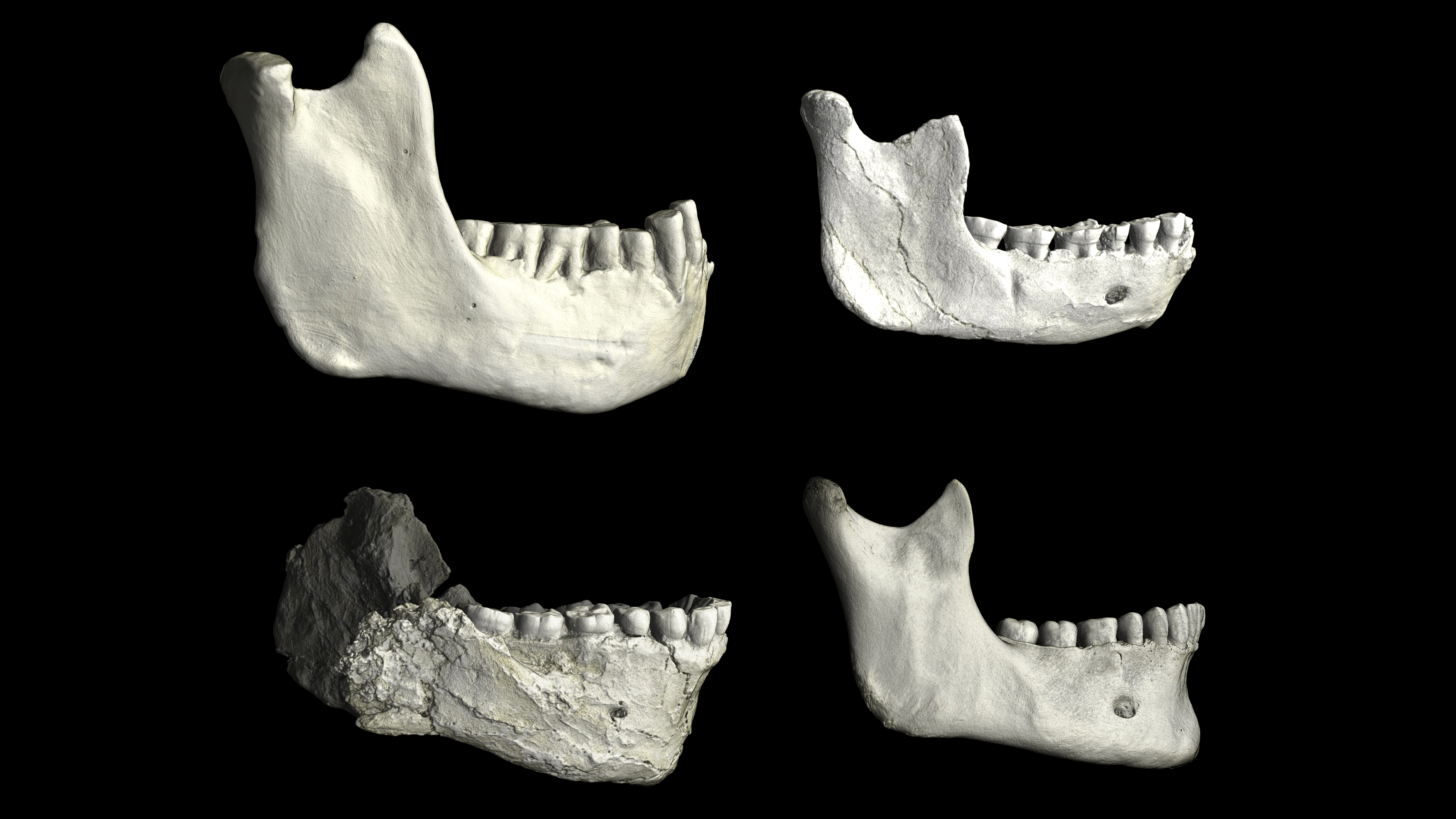
The evolutionary contrasts in brain size and face morphology embodied by the broadly contemporaneous DAN5/P1 and Kenyan fossils, KNM-ER 3733 and KNM-WT 15000 (Supplementary Figs.
10 and
11) imply complex population structure rather than simple coexistence of two different lineages in the African Early Pleistocene. It is likely that the contrasts documented here signal between-population variation (assuming a single
H. erectus species) in eastern Africa at 1.6–1.5 Ma. This view is consistent with previous depictions of
H. erectus as a polytypic species across its temporo-spatial range
9,
31,
32. The unique rift basin landscape of the East African Rift System, alongside the potential low population density of early Pleistocene hominins, could lead to population separation between the Horn of Africa and Lake Turkana lineages
33,
34. In this scenario, the Horn of Africa group retained the more archaic morphology of the population dispersing from Africa ~1.9 Ma, whereas the Kenyan group underwent greater in situ evolution. The more fragmentary Ethiopian
H. erectus record may support this north-south division, but the larger-brained BSN/P1
H. erectus fossils from younger deposits at Gona (1.26 Ma) implies subsequent population replacement or in situ evolution (Supplementary Discussion). Other interpretations are, of course, possible. For example, an expanded fossil record could reveal high within-population variation (but see ref.
35 or interbreeding could result in the mosaic of ancestral and more derived features


 elementy.ru